 Cruelty and xenophobia stir and shame the lucky country
The social regression and flag-waving promoted by Australia's neocon prime minister may come unstuck in Guantánamo
John Pilger
Friday January 19, 2007
Guardian
The Australian writer Donald Horne meant the title of his celebrated book, The Lucky Country, as irony. "Australia is a lucky country run by second-rate people who share its luck," he lamented in 1964, describing much of the Australian elite as unfailingly unoriginal, race-obsessed and in thrall to imperial power and its wars. From Britain's opium adventures to America's current travesty in Iraq, Australians have been sent to fight faraway people with whom they have no quarrel and who offer no threat of invasion. Growing up, I was assured this was a "sacred tradition".But then another Australia was "discovered". The only war dead whom Australians had never mourned were found right under their noses: those of a remarkable indigenous people who had owned and cared for this ancient land for thousands of years, then fought and died in its defence when the British invaded. In a land littered with cenotaphs, not one honoured them. For many whites, the awakening was rude; for others it was thrilling. In the 70s, thanks largely to the brief, brave and subverted Labor government of Gough Whitlam, the universities opened their studies to these heresies and their gates to a society Mark Twain once identified as "almost entirely populated by the lower orders". A secret history revealed that, long before the rest of the western world, Australian working people had fought for and won a minimum wage, an eight-hour working day, pensions, child benefits and the vote for women. And now there was an astonishing ethnic diversity, and it had happened as if by default: there simply were not enough Britons and "blue-eyed Balts" who wanted to come.
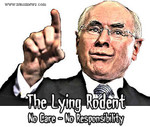
Australia is not often news, cricket and bushfires aside. That is a pity, because the regression of this social democracy into a state of fabricated fear and xenophobia is an object lesson for all societies claiming to be free. In power for more than a decade, the Liberal prime minister, John Howard, comes from the outer reaches of Australia's "neocons". In 1988 he announced that a future government led by him would pursue a "One Australia Policy", a forerunner to Pauline Hanson's infamous One Nation party, whose targets were black Australians and migrants. Howard's targets have been similar. One of his first acts as prime minister was to cut $A400m from the Aboriginal affairs budget. "Political correctness," he said, "has gone too far." Today, black Australians still have one of the lowest life expectancies in the world, and their health is the worst in the world. An entirely preventable disease, trachoma - beaten in many poor countries - still blinds many because of appalling living conditions. The impoverishment of black communities, which I have seen change little over the years, was described in 2006 by Save the Children as "some of the worst we have seen in our work all around the world". Instead of a political respect in the form of a national lands rights law, a war of legal attrition has been waged against the Aborigines; and the epidemics and black suicides continue.
Howard rejoices in his promotion of "Australian values" - a very Australian sycophancy to the sugared "values" of foreign power. The darling of a group of white supremacists who buzz around the Murdoch-dominated press and radio talk-back hosts, the prime minister has used acolytes to attack the "black armband view of history", as if the mass killing and resistance of indigenous Australians did not happen. The fine historian Henry Reynolds, author of The Other Side of the Frontier, has been thoroughly smeared, along with other revisionists. In 2005 Andrew Jaspan, a Briton newly appointed editor of the Melbourne Age, was subjected to a vicious neocon campaign that accused him of "reducing" the Age to "another Guardian".
Flag-waving and an unctuous hand-on-heart jingoism, about which sceptical Australians once felt a healthy ambivalence, are now standard features at sporting and other public events. These serve to prepare Australians for renewed militarism and war, as ordained by the Bush administration, and to cover attacks on Australia's Muslim community. Speak out and you may break a 2005 law of sedition meant to intimidate with the threat of imprisonment for up to seven years. Once described in the media as Bush's "deputy sheriff", Howard did not demur when Bush, on hearing this, promoted him to "sheriff for south-east Asia". Like a mini-Blair, he has sent troops and federal police to the Solomon Islands, Tonga, Papua New Guinea and East Timor. In newly independent East Timor, where Australian governments colluded with Indonesia's 23-year bloody occupation, "regime change" was effectively executed last year with the resignation of the prime minister, Mari Alkatiri, who had the temerity to oppose Canberra's one-sided exploitation of his country's oil and gas resources.
However, it is one man, David Hicks, a spectacular loser in the new Australia, who now threatens Howard's "lucky" facade. Hicks was found among the Taliban in Afghanistan in 2001 and sold as bounty to the Americans by CIA-backed warlords. He has spent more than five years in Guantánamo Bay, including eight months in a cell with no sunlight. He has been tortured, and never charged with any crime. Howard and his attorney-general, Philip Ruddock, have refused even to request Hicks's repatriation, as is his constitutional right, because there are no Australian laws under which Hicks can be charged. Their cruelty is breathtaking. A tenacious campaign by his father, Terry, has ignited a kind of public shame that is growing. This has happened before in Australia, such as the march of a million people across Sydney Harbour Bridge demanding justice for black Australians, and the courageous direct action by young people who forced the closure of notorious outback detention camps for illegal refugees, with their isolation cells, capsicum spray and beatings. Asylum seekers caught in their leaking boats by the ever-vigilant Australian Defence Force are now incarcerated behind electric fences on tiny Christmas Island more than 1,000 miles from the lucky country.
Howard faces no real opposition from the compliant Labor party. The trade unions, facing a rollback of Australia's proud record of workers' rights and up to 43% youth unemployment, have stirred, and filled the streets. But perhaps something wider and deeper is coming from a nation whose most enduring and melancholy self-image is that of disobedient larrikins. During the recent Ashes series, Ian Chappell, one of Australia's most admired cricket captains, walked out of the commentary box when Howard walked in. After seeing for himself conditions in a refugee prison, Chappell said: "These are human beings and you can't just treat them like that ... in cricketing parlance it was like cheating. They were being cheated out of a fair go."
www.johnpilger.com
Guardian Unlimited © Guardian News and Media Limited 2007


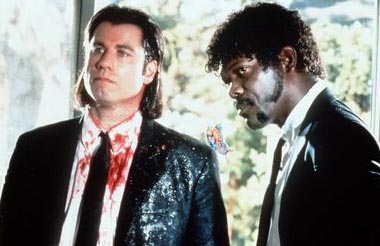 Virgin Radio, (Christian O'Connell, how do you feel?) to which I have the slight misfortune of listening to most days (hey, it ain't 6Music, but it certainly isn't the wrist slashing numbness that is Heart) has been plugging the absolute bejesus out of the latest John Travolta vehicle, Wild Hogs. Along with a relatively humiliating appearance on Jonathan Ross and a "mystery mechanical problem" with his personal 707, the publicity machine has been running overtime. Well, the reviews have hit the papers now, and surprise, surprise, it's no Wild Hog, more like a lame dog.







 Posts
Posts


